
How to Write Facebook Ad Copy using AI
Learn how to write Facebook ad copy using AI and create scroll-stopping ads that drive real clicks and conversions. This guide covers the most effective AI frameworks for Facebook ads and shows you exactly how to use WordWriter’s Facebook Ad Copy template to write high-performing copy in minutes.
What Is AI Facebook Ad Copy?
AI Facebook ad copy is advertising text written with the help of artificial intelligence tools. These tools use large language models trained on vast amounts of marketing and conversion data to help you generate headlines, hooks, body copy, and calls to action quickly and efficiently.
The goal is not to hand your brand voice over to a machine. It is to remove friction from the writing process so you can produce more variations, test more angles, and spend your energy on strategy rather than grinding through a draft that is not working. The best AI-generated ad copy feels like it came from someone who genuinely understands your customer, and with the right tool and a little refinement, it absolutely can.
Facebook ads are unforgiving. You have a matter of seconds, a headline, and a line or two of body copy to make someone care enough to stop and click. Every word has to earn its place. AI helps you move faster, think wider, and write sharper, but only when you know how to use it well.
What Are the 7 Most Effective AI Frameworks for Facebook Ad Copy?
Before you open any tool and start generating, it helps to understand the frameworks that make ad copy actually work. AI is most powerful when it is given a structure to work within. These seven frameworks are trusted by professional copywriters and performance marketers, and they translate exceptionally well when used as prompting strategies inside AI writing tools.
1. AIDA (Attention, Interest, Desire, Action)
AIDA is one of the oldest and most reliable copywriting frameworks in existence, and it works just as well in a Facebook ad as it does in a sales letter.
You grab attention with a bold hook, build interest by speaking to something your audience already cares about, create desire by painting a picture of what life looks like with your product, and close with a clear action. When prompting AI with this framework, ask it to structure the output in these four stages and you will almost always get a more coherent, conversion-focused result.
2. PAS (Problem, Agitate, Solution)
PAS is particularly effective for products that solve a specific pain point. You open by naming the problem your audience is experiencing, then you agitate it by making them feel the weight of it, and then you introduce your product as the relief.
It is emotionally driven copy and it works because it mirrors the way people actually think when they are looking for a solution. AI handles this framework well because the structure is clear and the emotional progression is easy to follow.
3. FAB (Features, Advantages, Benefits)
A lot of ad copy fails because it focuses too much on what a product is and not enough on what it does for the customer. FAB fixes that. You lead with the feature, explain the advantage it creates, and then land on the benefit that actually matters to the buyer.
When you use this framework with AI, make sure your prompt includes the specific features you want highlighted so the output stays grounded in your actual product.
4. The Hook, Story, Offer Framework
This one is especially powerful for Facebook video ads and longer-form copy. You open with a hook that disrupts the scroll, follow it with a short relatable story that builds connection and context, and then present your offer as the natural next step.
It feels less like an ad and more like a conversation, which is exactly what performs well in a social feed. AI can generate compelling story angles quickly when you give it enough context about your audience and what they care about.
5. The 4 U’s (Urgent, Unique, Ultra-specific, Useful)
This framework is less about structure and more about a quality checklist. Every line of your ad copy should ideally tick at least two or three of these boxes. Is there urgency? Does it feel different from every other ad in the space? Is it specific enough to feel credible?
Does it offer something genuinely useful to the reader? When you prompt AI using the 4 U’s as evaluation criteria, you can ask it to generate copy and then immediately ask it to score and improve each element.
6. Before and After Bridge (BAB)
BAB paints a clear contrast between where your audience is now and where they could be with your product. You describe their current situation, show them the transformation, and then bridge the gap with your offer.
It is aspirational without being unrealistic, and it works incredibly well for lifestyle products, coaching services, software tools, and anything that promises a meaningful change. AI generates strong BAB copy when your prompt includes honest, specific details about both the pain state and the desired outcome.
7. The Curiosity Gap Framework
This one leans into the psychology of open loops. You say just enough to make the reader feel like they are missing something important, then you use the call to action to close the loop.
Headlines like “Most businesses are making this one mistake with their Facebook ads” or “There is a reason your ads are getting clicks but not conversions” work because they create an itch the reader needs to scratch. AI is surprisingly good at generating curiosity-gap hooks when you prompt it to lead with a surprising angle or a counterintuitive truth about your niche.
Related Read: AI Writing Workflow for Content Teams
How to Write Facebook Ad Copy Using WordWriter
Now that you understand the frameworks, here is how to put them into action using WordWriter’s dedicated Facebook Ad Copy template.
Step 1: Sign In to Your WordWriter Account
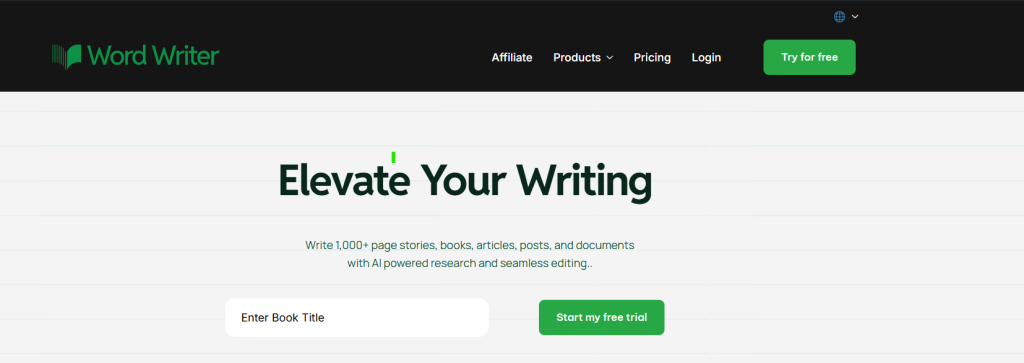
Head over to WordWriter and log in to your account. Once you are on the dashboard, look to the left side panel and click on Templates.
Step 2: Find the Facebook Ad Copy Template
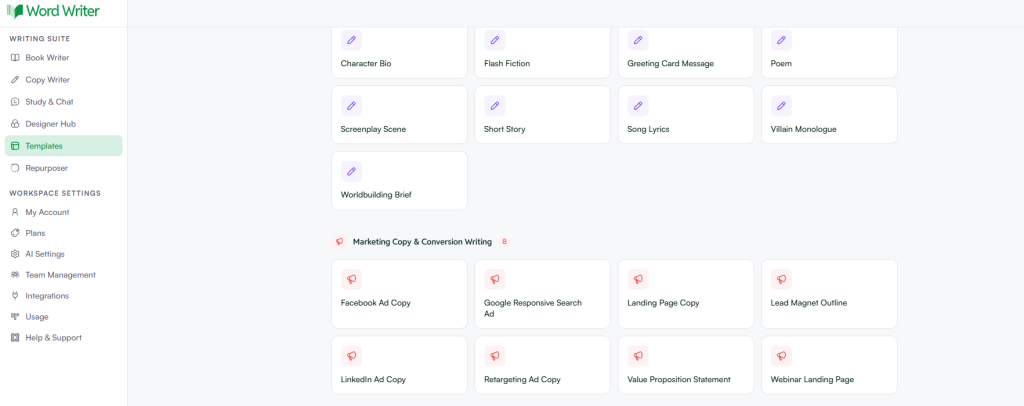
Under the Templates section, scroll until you find the Marketing Copy and Conversion Writing category. Inside that category, you will see the Facebook Ad Copy template. Tap on it to open it.
Step 3: Fill in the Prompts
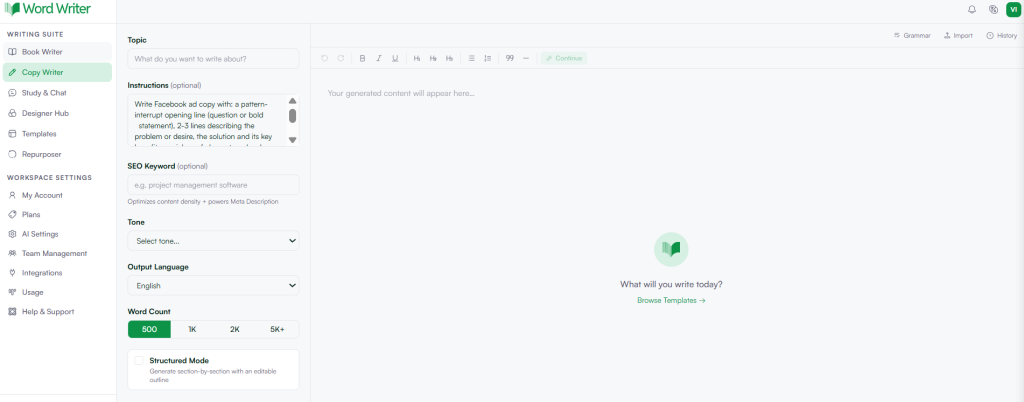
The template will present you with a series of fields and instructions. These typically ask for details like your product or service name, what you are promoting, your target audience, the tone you want, and the key benefit or offer you want to highlight.
This is where your framework knowledge comes in. Reference the framework you want to use inside the prompt fields to steer the output in the right direction. The more specific you are here, the stronger your output will be.
Step 4: Generate Your Ad Copy
Once you have filled in the prompts, hit generate. WordWriter will produce ad copy variations you can review, tweak, and test. You are not locked into the first output either. Adjust your inputs, try a different framework angle, and regenerate until you have something that truly fits your campaign.
Step 5: Edit and Personalize
This is where your human touch matters most. Read through the generated copy and refine it to match your brand voice. Swap out any phrase that feels generic, sharpen the hook, and make sure your call to action is direct and compelling. AI gives you the foundation. You give it life.
Read: How to write a case study using AI
Start Writing Ads That Actually Convert
Facebook advertising rewards copy that is clear, specific, and emotionally resonant, and now you have both the frameworks and the workflow to produce exactly that.
WordWriter’s Facebook Ad Copy template takes the guesswork out of where to start and gives you a structured, efficient path from idea to publish-ready ad. Sign in to WordWriter today, open the template, and write your next best-performing ad in minutes.
