
How to Create Myth-Busting Article Using AI
Have you ever seen a post online saying something like “drinking water every day is a lie” or “your phone will damage your eyes”? You stop, you read it, and you want to share it. That is the power of a myth-busting article. It grabs attention fast because it challenges what people already believe.
Writing this type of article is one of the best ways to grow your audience online, fight false information, and get people to share your content.
In this article, we will walk you through what myth-busting articles are, why they work so well, how to choose the right myth to write about, and a simple step-by-step process for writing one from start to finish. We will also show you how a tool called WordWriter can make the whole process faster and easier, even if you have never written this type of article before.
Let’s dive in
What Are Myth-Busting Articles?
A myth-busting article is a piece of writing that takes a popular false belief, states it clearly, and then proves it wrong using real facts and evidence.
The idea is simple. People believe a lot of things that are not true. Some of these beliefs have been passed around for so long that they feel like common sense. A myth-busting article steps in and says, “Actually, that is not correct, and here is the proof.”
For example, many people believe that you need to drink exactly eight glasses of water every day to stay healthy. That sounds reasonable. But when you check the science, there is no single number that works for every person. Your water needs depend on your weight, your activity level, the weather, and what you eat. So the “eight glasses” rule is not based on solid medical evidence. A myth-busting article would explain all of this clearly, show the real facts, and help the reader walk away better informed.
These articles are not about making people feel foolish for believing something wrong. They are about replacing old, incorrect information with something accurate and useful. Done well, they educate without being harsh.
Related: How to Create a Book Chapter on WordWriter
Why Myth-Busting Articles Are So Effective
Before we get into how to write one, it helps to understand why this type of content works so well. Once you understand the reason, writing becomes easier because you know exactly what you are trying to do.
1. They Pull People In Immediately
A headline that challenges a common belief is very hard to ignore. When someone sees “The ‘Eight Glasses of Water a Day’ Rule Is Not Real,” they stop scrolling. Even if they are not sure whether to believe it, they want to find out. That curiosity is what drives clicks.
This is not manipulation. People are naturally drawn to information that challenges what they think they know. It is how humans learn. When something surprises us, we pay closer attention. A good myth-busting article uses this natural reaction to get readers engaged from the very first line.
2. Readers Share Them Widely
When someone reads an article and discovers that something they believed for years is actually false, two things usually happen. First, they feel surprised. Second, they immediately want to tell someone else. This is why myth-busting articles get shared so often on social media and in group chats.
People share content that makes them look informed. When your article gives them new and accurate information, they become the person sharing the truth. That feels good, and it keeps your content moving from one person to the next without you doing anything extra.
3. They Position You as Someone Who Knows What They Are Talking About
There is a big difference between someone who repeats popular opinions and someone who actually checks whether those opinions are correct. Myth-busting articles put you in the second group. When your audience sees that you regularly correct false information with proper facts, they start to trust you more than other sources.
This kind of trust is hard to build and very valuable. It means that when you publish something new, people already believe it will be worth reading. Over time, this trust grows into a loyal audience.
4. They Stay Useful for a Long Time
Most myths do not disappear quickly. People will still be believing false things about nutrition, health, money, technology, and relationships for years to come. This means a well-written myth-busting article does not go out of date quickly. Someone can find it six months or two years after you published it and still find it completely useful. That kind of content keeps bringing in new readers long after you wrote it.
Step-by-Step: How to Write a Myth-Busting Article
Now that you understand what this type of article is and why it works, here is exactly how to write one from start to finish.
Step 1: Start With the Myth, Not the Facts
Many writers make the mistake of jumping straight into the correct information. Do not do this. Start by stating the myth clearly and directly. Let your reader recognize it. Give it space on the page.
For example: “You have probably heard that eating late at night makes you gain weight. It is one of the most repeated pieces of diet advice out there.”
This opening works because the reader immediately sees something familiar. They may even believe this themselves. Now they are curious about what comes next.
Step 2 — Acknowledge Why People Believe It
Before you prove the myth wrong, take a moment to explain why it exists in the first place. Most myths do not come from nowhere. They usually started as a half-truth, a misunderstood study, or a piece of advice that got repeated and stretched over time.
Acknowledging this shows your reader that you are not mocking them for believing something wrong. It shows that you understand how the false belief spread. This makes your writing feel fair and respectful.
For example: “This idea became popular because some early studies showed that people who ate late at night tended to weigh more. But those studies did not look closely at what those people were eating or how much. The time of eating was blamed, but the real issue was total calories consumed.”
Step 3 — Present the Real Facts Clearly
This is the main part of your article. Take each piece of false information and replace it with accurate information. Use real sources. Mention studies, organizations, or experts where possible. Keep the language simple and direct.
Do not use complicated words when simple ones will work. Your job is not to impress the reader with how much you know. Your job is to help them understand something they did not understand before.
For example: “Research published by nutrition scientists has found that the body does not automatically store food as fat just because you eat at night. What matters most is how many calories you consume across the whole day, not the time on the clock when you eat them.”
Step 4 — Use Real Examples
Abstract facts are harder to remember than specific examples. After you state the correct information, give your reader a real-world example that makes it easy to understand.
For example: “Think about someone who eats a light breakfast, a medium lunch, skips dinner, and then has a small snack at 10pm. Their total calorie intake for the day is still low. They are not going to gain weight from that late snack simply because of the time.”
Examples like this make the facts feel real and practical. They show the reader how the information applies to actual life.
Step 5 — Close With a Clear Summary
End your article by restating the main point simply. Remind your reader what the myth was, what the truth is, and why it matters. Keep this section short. Two to four sentences is usually enough.
For example: “Eating late at night does not automatically cause weight gain. What matters is your total food intake for the day. If you are eating within your calorie needs, the time you eat has little effect on your weight.”
Related: 10 Best AI Book Writing Tools for 2026
Step-by-Step: How to Create Myth-Busting Articles with WordWriter
You don’t need to spend three days digging through old research papers or arguing with a blank screen. WordWriter has a built-in framework that organizes your ideas into a flawless “Myth vs. Fact” structure. Here is how it is done:
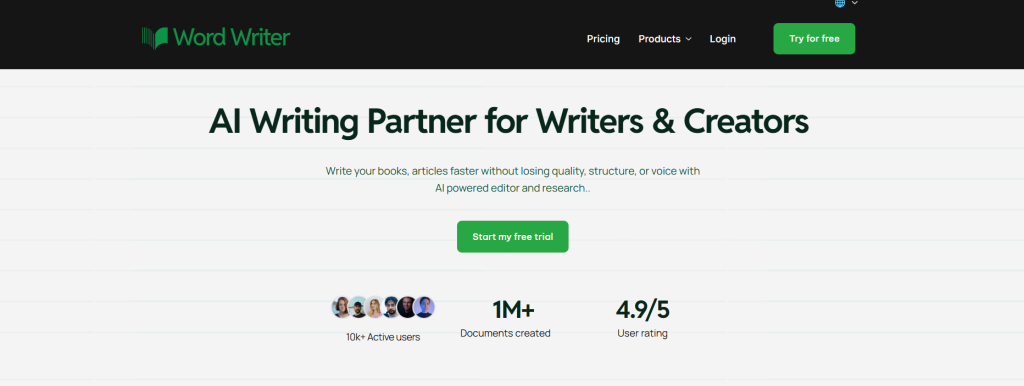
1. Login to Your Workspace
First, visit the official website and login to your WordWriter dashboard. If you are a new user, you can set up your creative account in seconds.
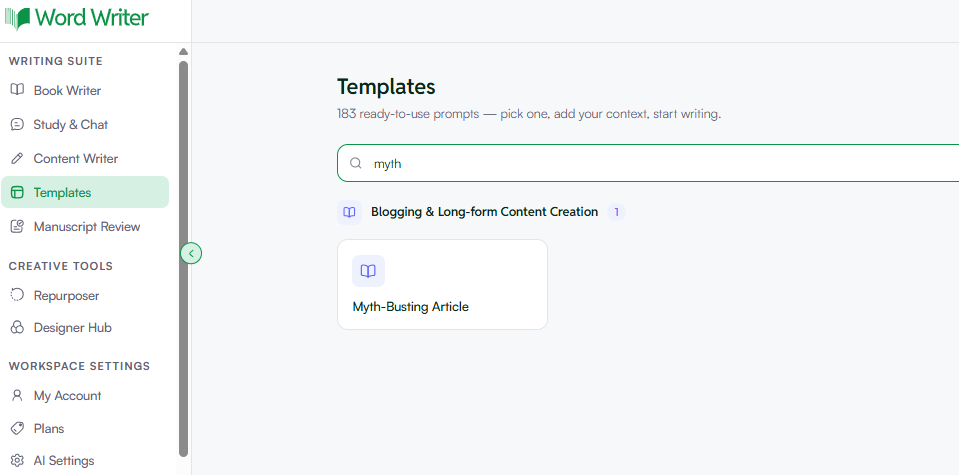
2. Locate the Article Template
Head over to the Template Section on your dashboard navigation menu. Type “Myth Article” into the search bar, select the specialized myth-busting article framework, and click on it.
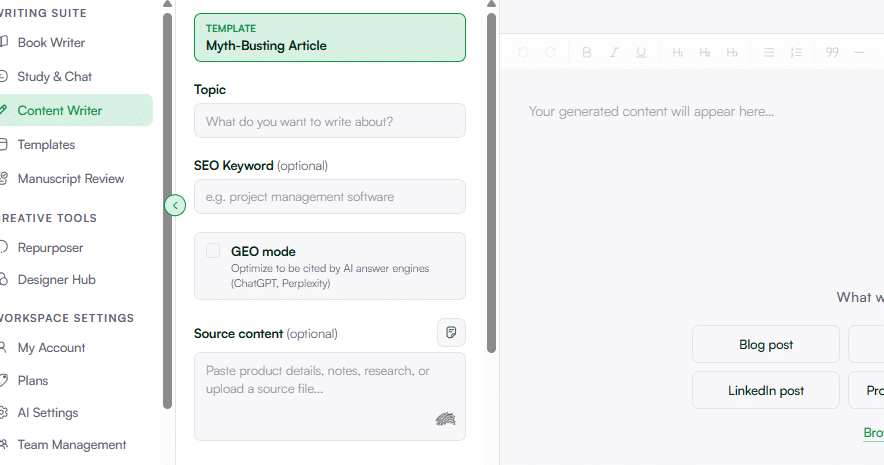
3. Fill the Quick Preset Area
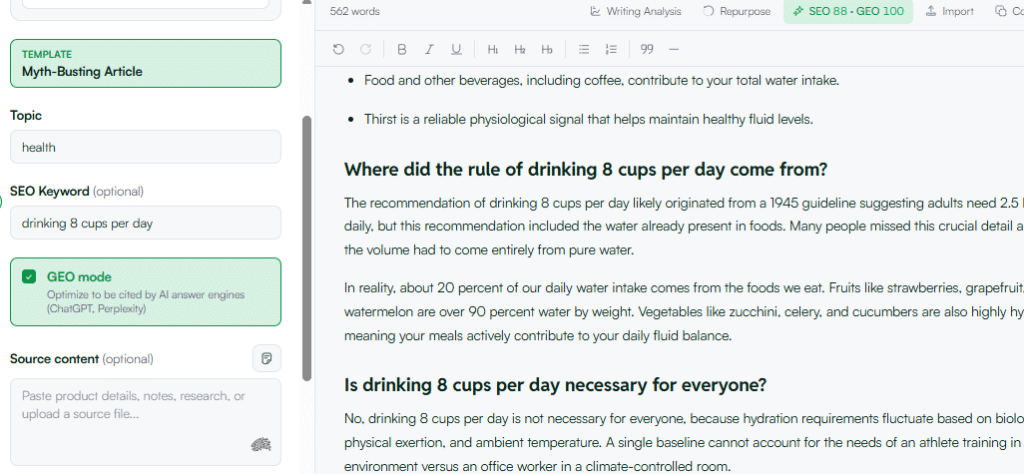
This is where you give the AI the exact boundaries for your piece. You will fill out the quick preset form:
- Topic/Myth: Type in the rumor you want to destroy (e.g., “Smashed avocados are the reason millennials can’t afford houses.”)
- Tone: Choose how you want to sound. For myth-busting, options like ‘informative’, ‘witty’, or ‘persuasive’ work beautifully.
- The Geo Option: This is the ultimate tool for modern creators. In the presets, the GEO (Generative Engine Optimization) option can be clicked. By activating this, WordWriter will automatically structure the facts, schema, and direct answers in your article so that it is perfectly built to get cited and featured inside AI search engines like Perplexity, Gemini, and ChatGPT when users ask about this myth!
- Word Count: Select your desired length (500, 1K, 2K, or 5K+ words) based on how deep you want to go.
4. Polish and Shape in the AI Editor
Hit generate, and WordWriter will instantly cook up a perfectly structured article complete with a catchy hook, the myth introduction, the real data, and a summary. Open it up in the Smart AI Editor to add your own personal style, rearrange paragraphs, or drop in custom links.
5. Export and Publish
Once you’re completely happy with your myth-shattering draft, export the file as a PDF, Word document, or clean Markdown, and it’s 100% ready to go live on your blog or newsletter!
Conclusion
A myth-busting article is one of the most useful types of content you can create. It helps your readers, builds your reputation, and gives people a reason to share your work. The key is to choose a real and widely believed myth, treat your reader with respect, present accurate facts clearly, and use examples that make the information easy to apply.
With a tool like WordWriter, you do not have to start from a blank page. The structure is already there. You just need to bring your knowledge, check the facts, and add your own voice.
Pick one myth in your area today. Write the article. Publish it. Then watch what happens when people realise something they believed for years was never actually true.
