
6 Best AI Writing Tools for Research Papers
Writing a research paper is one of the hardest things you will sit down to do. You have done the reading, you have the data, and you know what you want to say, but turning all of that into a structured, properly cited, academically sound paper is a different challenge entirely. The blank page does not care how much work went into the research behind it.
That is why so many researchers, students, and academics have turned to AI writing tools. Not to replace their thinking, but to remove the friction between what they know and what they can put on the page. In 2026, the options are better than ever, but they are not all equal, and they are definitely not all built for the same job.
This guide breaks down the best AI writing tools for research papers right now, what each one does well, what it does not, and which one deserves the top spot for serious researchers and content professionals alike.
Let’s dive in.
6 Best AI Writing Tools for Research Papers
1. WordWriter
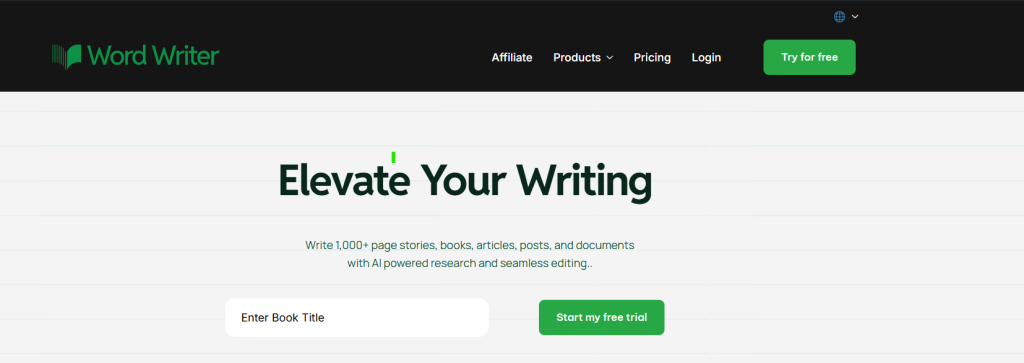
If you are writing research-heavy content, reports, whitepapers, long-form articles, book chapters, or academic-style documents, WordWriter is the most complete AI writing platform available today.
WordWriter is not a general-purpose AI assistant. It is a dedicated content creation platform built specifically for writers, researchers, authors, and content professionals. Every feature on the platform was designed around a single goal: getting you from a research topic to a finished, polished, publication-ready document as efficiently as possible.
What makes it stand out for research writing:
WordWriter includes a dedicated Research Agent capable of generating up to 200-page research reports, complete with citations and references. You input your topic, set your parameters, and the agent builds a structured, sourced document, not just a summary, but a full long-form output with a coherent argument and cited evidence. For researchers, content strategists, and non-fiction writers, this capability is genuinely rare.
Beyond research, WordWriter’s platform includes 100+ writing templates covering every major content format, a guided preset panel where you define your topic, audience, tone, output language, and word count before generating, a built-in full editor, an AI-Powered Keyword Assistant for SEO, an AI image and chart generator, a podcast generator, speech-to-text input, and content repurposing tools that convert audio and video into written formats.
For authors working on book-length research, the Infinity plan includes a dedicated Book Agent that builds complete manuscripts chapter by chapter, with outlines and references built into the workflow. It supports multiple active books at a time, something no general-purpose AI tool can match at the structural level.
WordWriter Pricing, Billed Yearly
WordWriter offers three straightforward plans, all billed yearly, with a free trial available on every tier. No guessing, no hidden fees.
The Basic plan is $9 per month billed yearly and gives you 100,000 words per month. It includes 280+ writing templates, the Book Writer, Study and Chat, Content Repurposer, AI research and image generator, Fiction Engine, Full Word Editor and Analyser, multilingual support, export and integrations, and full copyright ownership over everything you create.
The Pro plan is $19 per month billed yearly and builds on everything in Basic. It scales up to 600,000 words per month and adds full-book review, the ability to generate all chapters in one go, AI trained on your writing style, expanded image generation, and priority support.
The Infinity plan is $99 per month billed yearly and is built for high-output writers and teams. It includes everything in Pro plus 3,000,000 words per month, the full Book Engine, team management features, and dedicated support.
Every plan comes with a free trial so you can explore the platform before committing. And compared to most AI tools on the market, WordWriter’s Basic plan at $9 per month gives you one of the most complete content creation toolkits available at that price point.
Best for: Researchers, non-fiction authors, content marketers, bloggers, and academics who produce long-form written content regularly and want a structured, template-driven workflow without a recurring subscription.
2. Jenni AI
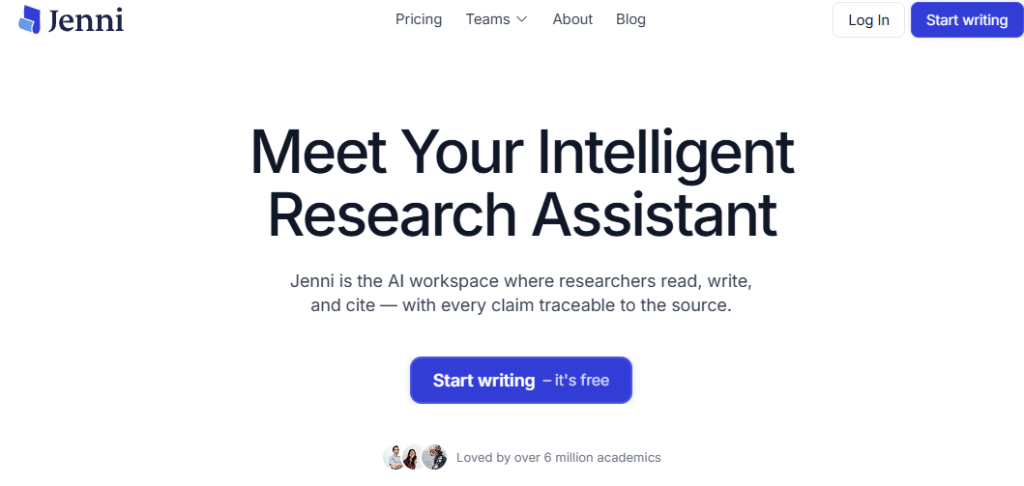
Jenni AI is built around a simple but powerful idea: as you write, the AI suggests the next sentence or paragraph, and every suggestion is drawn from your own uploaded PDF library, linked to a specific page and paragraph. This grounds completions in your actual source materials rather than AI training data, which significantly reduces citation hallucination.
It is not a full research platform. It does not discover literature or manage references across a large corpus. But for researchers who have already gathered their sources and want AI assistance that stays closely tied to those sources as they draft, Jenni is one of the most practical tools available.
Key features:
- Source-grounded autocomplete linked to uploaded PDFs
- In-text citation insertion as you write
- Clean, distraction-free writing interface
- Free tier: 10 autocompletes per day
Pricing: Free tier available. Paid plans from around $20 per month.
Best for: Researchers and graduate students who have their literature ready and want AI-assisted drafting that stays tightly grounded in their own sources.
3. Writefull
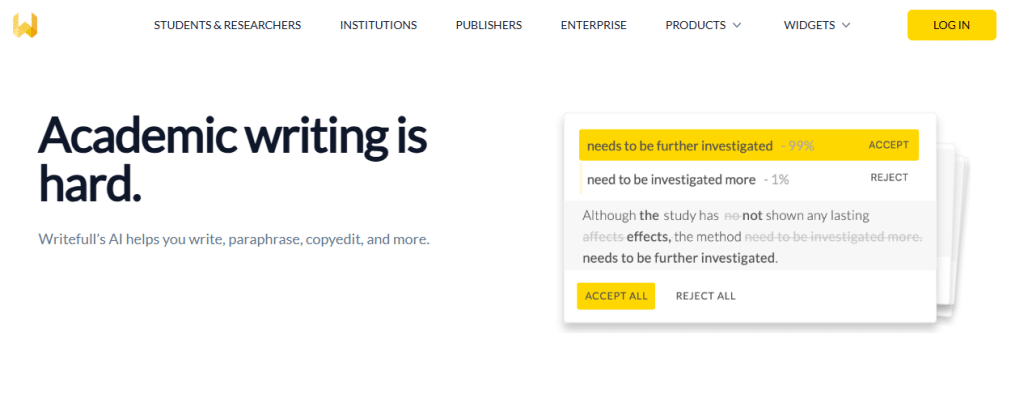
Writefull is trained specifically on published academic literature, which makes it uniquely well-suited to the language register that journals expect. It is not a drafting tool, it is an editing and language polish tool. It surfaces real-time suggestions for grammar, clarity, vocabulary, and academic phrasing, tuned by discipline.
It integrates directly with Overleaf and Microsoft Word, which makes it a natural fit for STEM researchers who work in LaTeX environments. For non-native English researchers in particular, Writefull can meaningfully close the gap between a strong piece of research and the kind of clear, journal-ready English that increases acceptance rates.
Key features:
- Academic language suggestions trained on published literature
- Direct integration with Overleaf and Microsoft Word
- Discipline-specific phrasing recommendations
- Free daily quota available
Pricing: Free tier available. Paid plans available for individuals and institutions.
Best for: STEM researchers, non-native English writers, and anyone in the final editing stage of a manuscript before journal submission.
4. QuillBot
QuillBot is one of the most widely used AI tools among students and researchers for a straightforward reason: its core paraphrasing and grammar features are genuinely useful and available for free. The Academic mode produces output in a register appropriate for research writing, and the summariser handles long documents quickly.
It is not a research or drafting platform. It will not write your paper or manage your citations. But as a free, reliable tool for paraphrasing sections, improving sentence clarity, and running grammar checks, it has earned its place in the research writing toolkit.
Key features:
- AI paraphrasing with multiple tone modes including Academic
- Grammar checker
- Summariser for long documents
- Citation generator
- Free core features
Pricing: Free. Premium from around $9.95 per month.
Best for: Students and researchers on a budget who need a solid paraphrasing and grammar tool without a paid subscription.
5. Elicit

Elicit is not a writing tool in the traditional sense. It is an AI research assistant built specifically for literature review, finding papers, extracting key findings, mapping methods and results across multiple studies, and helping researchers identify gaps in the existing evidence.
For researchers at the early stages of a project, before writing begins, Elicit reduces the time spent manually reading and synthesising dozens of papers. It does not write your paper. But it gives you a far clearer picture of the literature landscape before you start drafting, which makes the writing that follows considerably stronger.
Key features:
- Semantic search across academic literature
- Data extraction from papers, methods, samples, findings
- Evidence tables that map results across multiple studies
- Structured literature review support
Pricing: Free tier available. Paid plans for higher usage.
Best for: Researchers at the literature review and evidence mapping stage, before drafting begins.
6. Grammarly

For research paper writing specifically, Grammarly works best as a final-pass layer, catching the errors that remain after the main drafting and editing work is done. It is not trained on academic literature the way Writefull is, and it does not manage citations or research workflows. But its breadth of integration and ease of use make it a practical finishing tool.
Grammarly’s pricing breakdown is worth knowing before subscribing: the gap between $30 per month on monthly billing and $12 per month on annual billing catches users by surprise, and the 50% student discount available through SheerID makes the annual plan around $6 per month for verified students.
Key features:
- Real-time grammar, clarity, and tone suggestions
- Works across browsers, Word, Google Docs, and email
- Plagiarism checker on paid plans
- Student discount available
Pricing: Free. Premium from $12 per month (annual). Student discount available.
Best for: Writers who want an always-on grammar and clarity tool across every platform they work in.
Conclusion
AI writing tools have genuinely changed what is possible for researchers and content professionals in 2026. Tasks that used to take days, compiling a research report, structuring a long-form article, generating a first draft, now take hours. The friction has been dramatically reduced.
But not every tool is right for every job. The tools that work best for peer-reviewed academic submissions are different from the ones that work best for professional research content, long-form reports, and published writing.
For most researchers, writers, and content professionals, people who produce written work regularly and need a complete, reliable workflow from idea to finished document, WordWriter stands apart. It is the only tool on this list with a dedicated Research Agent for long-form sourced content, a Book Manuscript workflow, a built-in SEO Keyword Assistant, and lifetime pricing that means you pay once and own the platform forever.
The blank page is still yours to face. But with the right tool, it does not have to win. Sign up on wordwriter today!
