
WordWriter vs ChatGPT: What’s the Difference?
If you’ve ever tried to write something long, be it a blog post, a research paper, or a book, you know how quickly it stops being fun.
You start with one good idea. Then suddenly you’re drowning in browser tabs, scattered notes, and a blank page that refuses to fill itself.
Most writers don’t struggle with what to say. They struggle with everything that comes before and after the actual writing.
So when AI promised to make things easier, creators listened. Now the question is, which AI actually delivers? Do you go with ChatGPT – the tool everyone’s heard of – or WordWriter, a platform built specifically for long-form writing?
In this article, we will be comparing both tools side by side so you can decide which one actually belongs in your creative workflow.
What is ChatGPT?
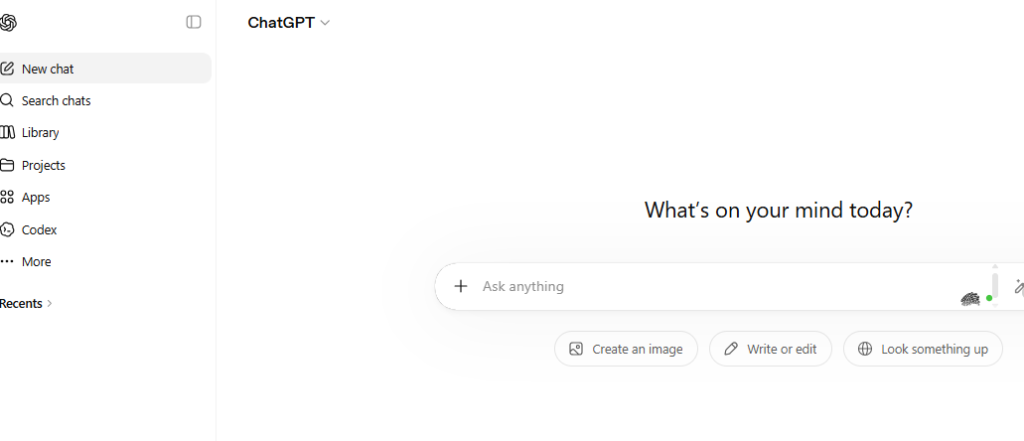
Launched by OpenAI, ChatGPT is a general-purpose, conversational large language model (LLM). Think of it as a hyper-intelligent, multi-lingual digital companion. Because it was trained on vast swathes of the internet, it can do almost anything you ask it to do: write a line of Python code, draft an email response to an angry client, compose a poem in the style of Shakespeare, or brainstorm business names.
ChatGPT operates entirely on a prompt-and-response dynamic. You type a prompt into a simple chat bar, and the AI streams back an answer. It doesn’t feature an inline word processor or built-in publishing tools; instead, it provides raw text generation power that you must copy, paste, and refine elsewhere.
What is Wordwriter?
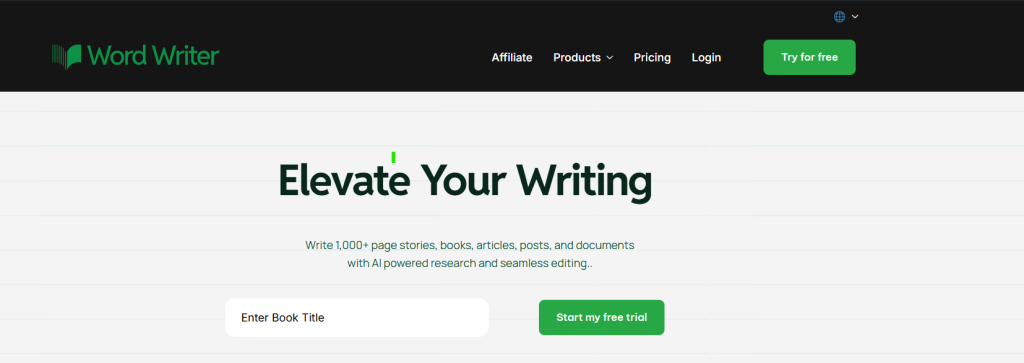
Wordwriter (developed by SalesGroup AI) is not a chat box—it is an all-in-one AI-powered writing ecosystem and document editor. Instead of trying to be a calculator or a coder, Wordwriter is laser-focused on authors, bloggers, marketers, and researchers who need to produce high-quality, long-form content.
Rather than a blank chat line, Wordwriter provides a full, distraction-free document editor integrated with niche AI modules. It features an automated Research Agent that pulls real-world data and web sources directly into your workspace, a Fiction/Book Engine that tracks plot consistency and character sheets up to 150 pages, a native Content Repurposer, and built-in exporting tools for formats like PDF, DOCX, and ePub.
Related: Wordwriter vs Gemini: Spot the Difference
Key Differences Between Wordwriter and ChatGPT
While both tools use advanced machine learning to generate text, they approach the creative process from entirely different angles.
1. The Workspace: Conversational Box vs. Full Word Editor
ChatGPT: You are confined to a scrolling chat window. If ChatGPT generates a 2,000-word essay, you cannot edit the text inside the chat. You have to copy the text, paste it into Google Docs or Microsoft Word, and do your manual editing there.
Wordwriter: It provides a rich-text native editor and analyser. The AI generates content directly into your active document. You can highlight a paragraph, ask the built-in AI to expand or rewrite it, tweak the font formatting, and organize your work into nested project folders without ever shifting tabs. Wordwriter
2. Research and Fact-Checking Capability
ChatGPT: While newer versions can browse the web, ChatGPT is prone to “hallucinations” (making up facts or fake citations). It treats research as a conversational answer rather than an organized data pool.
Wordwriter: Includes a dedicated Research Agent and a Chrome Web Store extension called Research Clipper. When you browse the web, you can clip sources, URLs, and quotes directly into your Wordwriter citations panel with one click. The AI then synthesizes this real-world data directly into your manuscript, guaranteeing far higher factual accuracy. Chrome Web Store – Google
3. Long-Form Structure & Narrative Memory
ChatGPT: It suffers from “context window drift.” If you try to write a 50-page book chapter-by-chapter, ChatGPT will eventually “forget” what happened in Chapter 1, leading to major plot holes, lost formatting, and repetitive vocabulary.
Wordwriter: Built with a specialized Book Writer and Fiction Engine. It includes structured character sheets and a Consistency Checker that scans your entire multi-chapter manuscript to flag plot gaps or character inconsistencies automatically.
4. Direct Publishing and File Exports
ChatGPT: Outputs plain text or markdown code blocks. It cannot directly build a print-ready file. docrider.ai
Wordwriter: Built for the end-to-end publishing pipeline. Once your book or blog is complete, you can natively export it into structured ePub (for Kindle), PDF, or DOCX formats, or push it straight to a linked WordPress site.
5. Specialized Content Repurposing
ChatGPT: Requires you to write complex, multi-step prompts to turn a transcript into a blog post.
Wordwriter: Offers native, one-click apps to convert speech-to-text, transcribe and summarize YouTube videos, and turn dense PDFs into dozens of social media posts automatically.
Detailed Pricing Breakdown
1. ChatGPT Pricing
ChatGPT operates on a subscription model. As of May 2026, it has seven pricing tiers:
| Plan | Price | What You Get |
|---|---|---|
| Free | $0/month | GPT-5.3, basic chat, limited messages, ads in the US |
| Go | $8/month | More capacity than Free, ads still included |
| Plus | $20/month | GPT-5.5, Deep Research (10 runs/month), Sora, Codex, Agent Mode |
| Pro $100 | $100/month | 5x Plus usage limits, GPT-5.5 Pro, expanded Codex access |
| Pro $200 | $200/month | 20x Plus limits, 1M token context window, full model suite |
| Business | $20–$25/user/month | Shared workspaces, SAML SSO, 60+ app integrations, SOC 2 compliance |
| Enterprise | Custom pricing | Maximum security, governance, privately hosted options |
2. Wordwriter Pricing
WordWriter operates on a pay-once, own-forever model. There are no recurring monthly fees, and all tiers include the full toolkit (chapter writer, outline builder, AI cover creator, and citation tools) with future updates included.
| Feature | License Tier 1 | License Tier 2 | License Tier 3 (Best Value) |
| Price | $190 (One-time) | $390 (One-time) | $490 (One-time) |
| Words per Month | 30,000 (Renewable) | 100,000 (Renewable) | 300,000 (Renewable) |
| Active Books at a Time | 6 | 12 | 21 |
| AI Cover Images / Month | 10 | 15 | 30 |
| Recurring Fees | Never | Never | Never |
(Note: Wordwriter also offers a 7-day premium free trial with no credit card required, allowing you to test out the features risk-free.)
Why Wordwriter is the Best Choice for Serious Writers
While ChatGPT is an incredible tool for general knowledge, coding, and quick brainstorming, Wordwriter is fundamentally the superior platform for content creators and authors. Here is why:
1. It Eradicates “Prompt Fatigue”
Using ChatGPT effectively requires you to become a prompt engineer. You have to constantly remind it of your tone, your audience, and your formatting constraints. Wordwriter bypasses this completely with over 100+ hyper-targeted AI templates (AIDA copywriting, SEO blogs, full book outlines, and Amazon product descriptions). You simply fill out basic input fields, and the tool delivers perfect outputs.
2. Built-In Creative Infrastructure
ChatGPT treats text as transient data inside a chat bubble. Wordwriter treats text as an asset. Features like the Character Sheet Tracker, the Mini-Book Feature (which builds organized chapters up to 150 pages in a single workflow), and the AI Style Trainer (which trains the AI to mimic your specific human voice) mean you are building a cohesive workspace, not just throwing text at a wall.
3. Multimodal Asset Creation in One Tab
If you are writing an article or a book chapter in ChatGPT and need a chart, an infographic, or an illustrative image, you have to bounce out to midjourney, Canva, or a separate app. Wordwriter integrates AI Image Generation, Infographics, Charts, and Video Generation right inside your dashboard, letting you create visual books and highly engaging SEO articles seamlessly.
Related: How to Write Facebook Ad Copy using AI
Conclusion
If you need a tool to help you debug a script, write a quick email reply, or answer a random historical question, ChatGPT is an accessible, brilliant conversational partner.
However, if your goal is to write a book, scale an SEO blog, manage deep research without losing your citations, or build a streamlined content marketing pipeline, Wordwriter is undeniably the better investment.
It takes the fragmented, exhausting parts of the modern writing process and unifies them into a singular, powerhouse ecosystem designed to help you create, edit, and publish seamlessly.
Start with Wordwriter today!
