
How to Write a Non-Fiction Book
Learning how to write a non-fiction book starts with one clear decision: choosing to share what you know in a way that helps others. Non-fiction books are built on ideas, experiences, and practical knowledge not imagination. Readers expect clarity, structure, and real value from the first page.
Many aspiring authors never start because they overthink the process. They worry about sounding like an expert, struggle to organize their ideas, or aim for perfection. The truth is simple: writing a non-fiction book doesn’t require perfection. It requires purpose, structure, and a clear plan.
In this guide, you’ll learn how to write a non-fiction book step by step from defining your core message to structuring chapters and writing with confidence. Whether you’re creating a personal development book, a business guide, or an educational resource, this guide will help you start strong and finish well.
Read: How to Write Better Sentences
Core Elements of Non-Fiction Writing (Detailed Explanation)
1. Clear Purpose
Every non-fiction book must have a reason for existing. Purpose is the foundation that holds the entire book together.
A clear purpose answers questions like:
- Why did I write this book?
- What specific problem does it address?
- What change should happen for the reader after reading it?
- Without a defined purpose, non-fiction writing becomes scattered. Chapters feel disconnected, ideas repeat unnecessarily, and readers struggle to understand the book’s value. A strong purpose keeps your writing focused and ensures every chapter contributes to the same goal.
Before writing, you should be able to summarize your book’s purpose in one sentence. If you can’t, the reader won’t be able to either.
2. Defined Audience
Non-fiction is not written for “everyone.” It is written for a specific group of people with specific needs.
Defining your audience means understanding:
- Their level of knowledge (beginner, intermediate, expert)
- Their background (professional, student, general reader)
- Their motivation (learning a skill, solving a problem, gaining insight)
When you know your audience, you make better writing decisions. Your tone becomes appropriate, your examples become relevant, and your explanations match the reader’s understanding. Without a defined audience, non-fiction often feels either too basic or too complex and ends up helping no one.
3. Credibility and Trust
Readers must believe you. If they don’t trust the writer, they won’t trust the message.
Credibility can come from:
- Direct experience with the topic
- Research and verified information
- Real-life examples or case studies
- Logical, well-reasoned explanations
You don’t need to be the world’s leading expert. What matters is honesty and accuracy. Acknowledge limits when necessary, cite sources when appropriate, and avoid exaggeration. Trust is built when readers feel the writer is informed, realistic, and transparent.
4. Structure and Organization
Structure determines how easy your book is to read and understand.
Strong non-fiction structure includes:
- A logical progression of ideas
- One clear main idea per chapter or section
- Headings that guide the reader
- Smooth transitions between topics
Good organization prevents confusion and cognitive overload. Readers should never wonder why a chapter exists or how one idea connects to another. When structure is clear, readers retain more information and are more likely to finish the book.
5. Clarity
Clarity is more important than style in non-fiction writing.
Clear writing uses:
- Simple, direct language
- Short, focused sentences
- Minimal jargon or technical terms
- Straightforward explanations
If a reader has to reread a sentence to understand it, the writing has failed. Clarity ensures your ideas are accessible and actionable. Non-fiction is not about sounding impressive, it’s about being understood.
6. Evidence and Support
Opinions alone are not enough in non-fiction. Claims need support to be credible and persuasive.
Support can come from:
- Research studies or statistics
- Personal experience and observations
- Case studies
- Real-world examples
Evidence strengthens your arguments and helps readers trust your conclusions. It turns abstract ideas into concrete insights and shows that your recommendations are grounded in reality, not assumption.
7. Practical Value
The primary goal of non-fiction is usefulness.
A strong non-fiction book helps the reader:
- Learn a skill
- Solve a specific problem
- Think differently about a situation
- Take clear next steps
Every chapter should deliver value. Readers should finish your book knowing what to apply, change, or act on. If nothing changes for the reader, the book has not fulfilled its purpose.
8. Consistent Voice
Your voice is how your writing sounds and feels to the reader.
A consistent voice is:
- Clear and recognizable
- Stable in tone throughout the book
- Appropriate for the target audience
Switching between formal and casual tones or changing writing style mid-book breaks trust. Consistency creates familiarity, which helps readers feel comfortable and connected to the writer.
9. Engagement
Non-fiction should hold attention, not just inform.
Engaging non-fiction uses:
- Strong openings that draw readers in
- Relatable examples and scenarios
- Direct, human language
- Clear relevance to the reader’s life
Facts and information are more memorable when they are presented in an engaging way. Engagement ensures readers stay interested long enough to absorb and apply what you’re teaching.
How to Write a Non-Fiction Story (Detailed Guide)
1. Start With a Real Experience
Every non-fiction story must be rooted in truth. The foundation of your story should be a real experience, moment, or situation that genuinely happened.
This could be:
- A personal experience
- A specific event you witnessed
- A situation that challenged or changed you
The key is relevance. Ask yourself: What happened that shifted my thinking, behavior, or understanding?
If nothing changed, there’s likely no story—just information
2. Find the Meaning
A non-fiction story is not defined by events alone. What makes it a story is the meaning behind those events.
To find the meaning, ask:
- What did I learn from this experience?
- Why does this moment matter?
- How is this relevant to the reader?
Without meaning, non-fiction becomes a report or a timeline of events. Meaning transforms facts into insight and helps readers connect emotionally and intellectually.
3. Open With a Scene
Strong non-fiction stories begin by placing the reader inside a moment rather than explaining the background.
Instead of summarizing, show:
- Where you were
- What was happening
- What you were thinking or feeling
Opening with a scene immediately engages the reader and creates curiosity. It gives context through experience rather than explanation, making the story feel real and immersive.
4. Follow a Clear Narrative Flow
Non-fiction stories still follow a narrative structure. This keeps the story coherent and easy to follow.
A clear structure includes:
- Beginning: Introduce the situation, setting, or tension
- Middle: Present the challenge, conflict, or turning point
- End: Offer resolution, insight, or reflection
The story should move forward logically. Avoid unnecessary jumps or distractions that break the reader’s focus.
5. Be Honest and Specific
Accuracy is essential in non-fiction storytelling. Readers expect the truth, not embellishment.
This means:
- No exaggeration
- No invented dialogue
- No altered outcomes
Specific details—real actions, real emotions, real consequences—build trust and emotional depth. Honesty strengthens credibility and makes the story more impactful.
6. Reflect Instead of Preaching
Non-fiction storytelling is about reflection, not instruction.
Rather than telling readers what to think:
- Show how your perspective changed
- Share what you realized over time
- Allow readers to draw their own conclusions
Reflection invites connection. Preaching creates distance. Readers relate more to vulnerability and self-awareness than authority.
7. Write Simply
Clear writing makes non-fiction powerful and accessible.
Effective non-fiction storytelling uses:
- Short, direct sentences
- Clear, everyday language
- A natural, conversational tone
Complex language does not equal depth. Simplicity ensures your message is understood and remembered.
8. End With Meaning
A strong non-fiction story ends with reflection, not just closure.
Ask:
- What stayed with me after this experience?
- What changed because of it?
- Why does this story matter now?
The ending should leave the reader thinking, not just finishing. Meaningful endings connect the personal experience to a broader truth or insight the reader can carry forward.
How to Write a Non-Fiction Book With WordWriter
WordWriter simplifies the process of writing a non-fiction book by guiding you from idea to full manuscript using AI-powered tools. Follow these steps to generate your non-fiction book efficiently.
Step 1: Sign In to Your WordWriter Dashboard

Start by signing in to your WordWriter account. Once logged in, you’ll be taken to your dashboard, where all writing tools and features are available.
Step 2: Open the Manuscript Writer
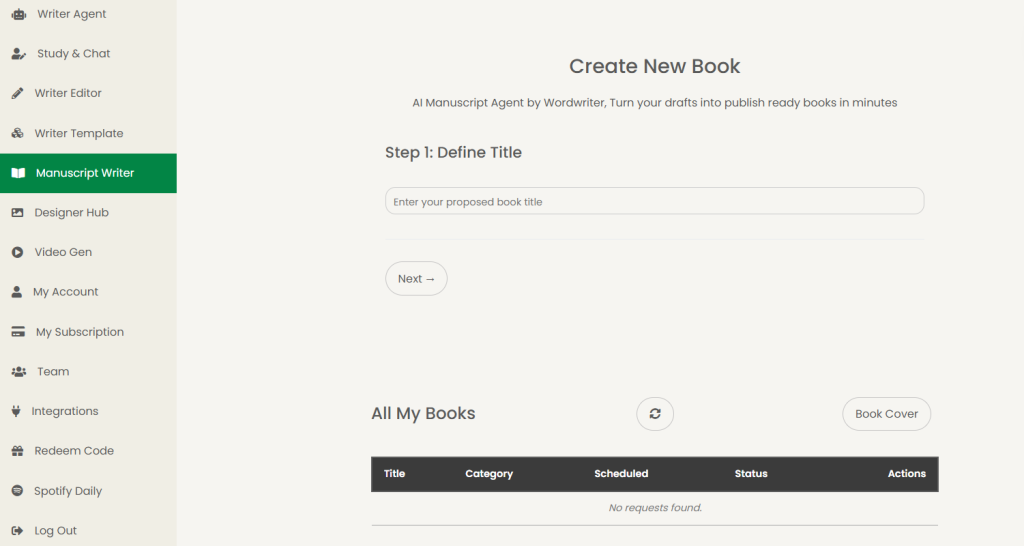
On the left side of your dashboard, locate and click on Manuscript Writer. This feature is specifically designed for long-form content such as books and manuscripts.
Selecting this option allows you to begin the book generation process.
Step 3: Enter Your Non-Fiction Book Title
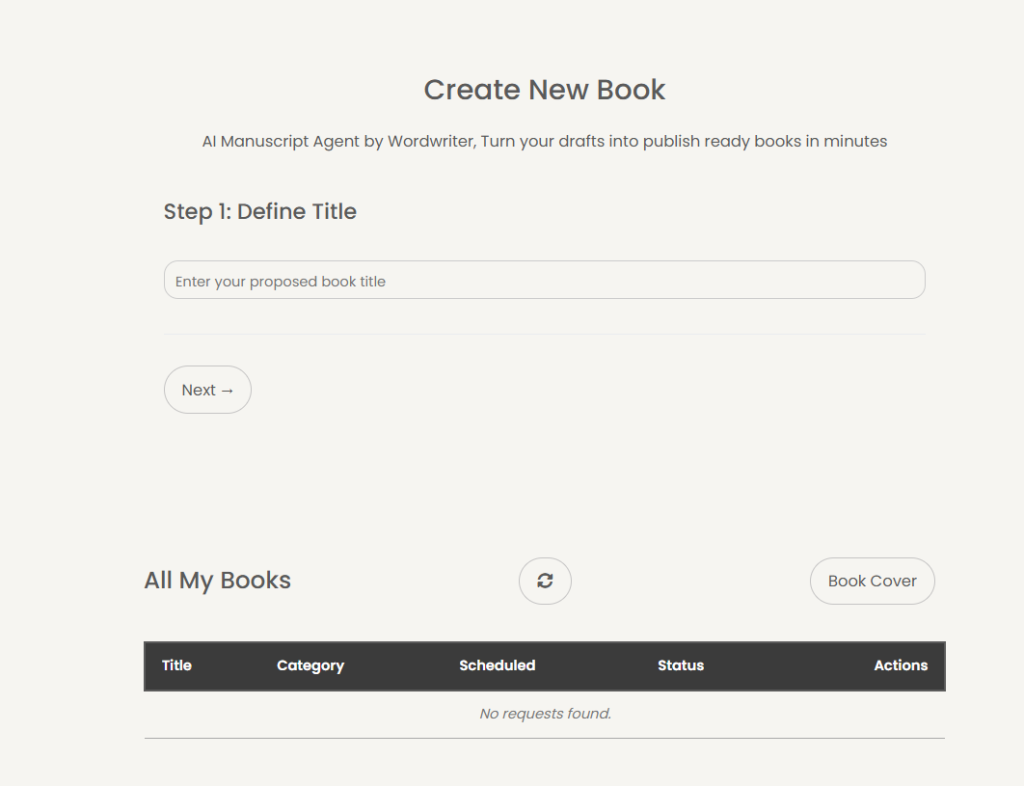
Inside the Manuscript Writer, you’ll see a field to input your book title.
Enter a clear and descriptive title that reflects:
- The main topic of your non-fiction book
- The problem you’re solving or value you’re offering
Your title helps guide the overall direction of the manuscript.
Step 4: Select the Book Category
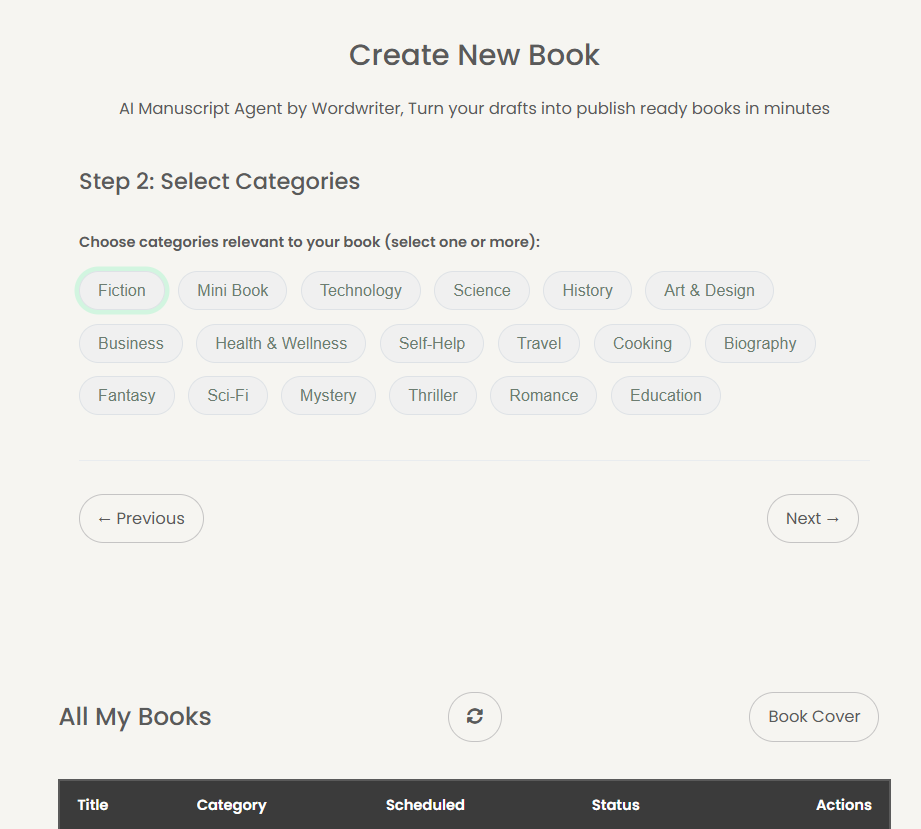
Next, choose the appropriate book category. Available options include:
- Fiction
- MiniBook
- History
- Art and Design
For non-fiction projects, select the category that best matches your book’s subject matter. This helps WordWriter structure your content correctly.
Step 5: Provide Your Content Details
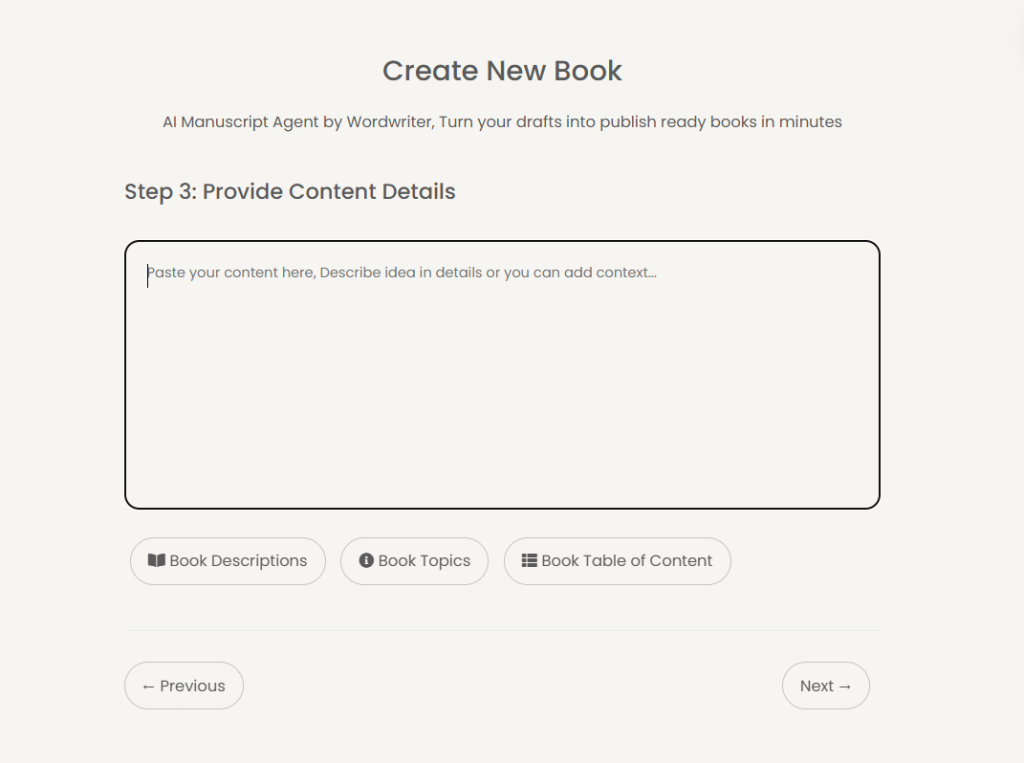
After selecting a category, you’ll be prompted to provide content details. This is where you define what your book will be about.
WordWriter gives you the option to generate:
- A book description
- Book topics or themes
- A table of contents
You can generate these automatically or customize them to align with your vision.
Step 6: Schedule Your Book Generation
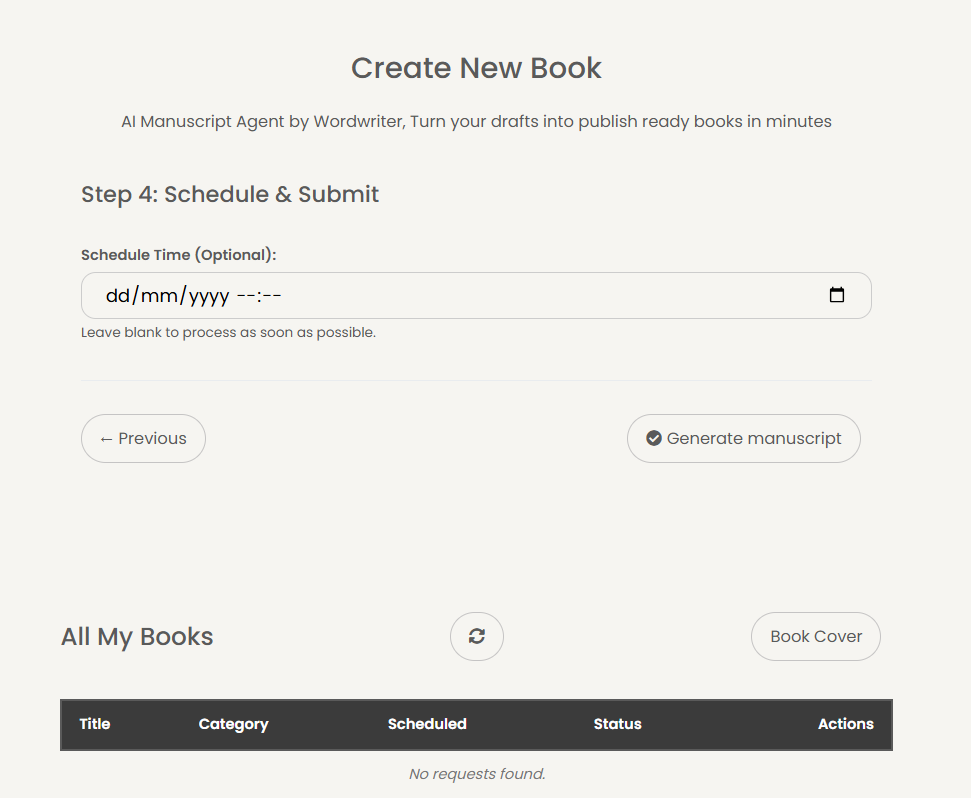
Once your content details are ready, schedule your manuscript generation. This allows WordWriter to organize and process your book content effectively.
Step 7: Generate Your Manuscript
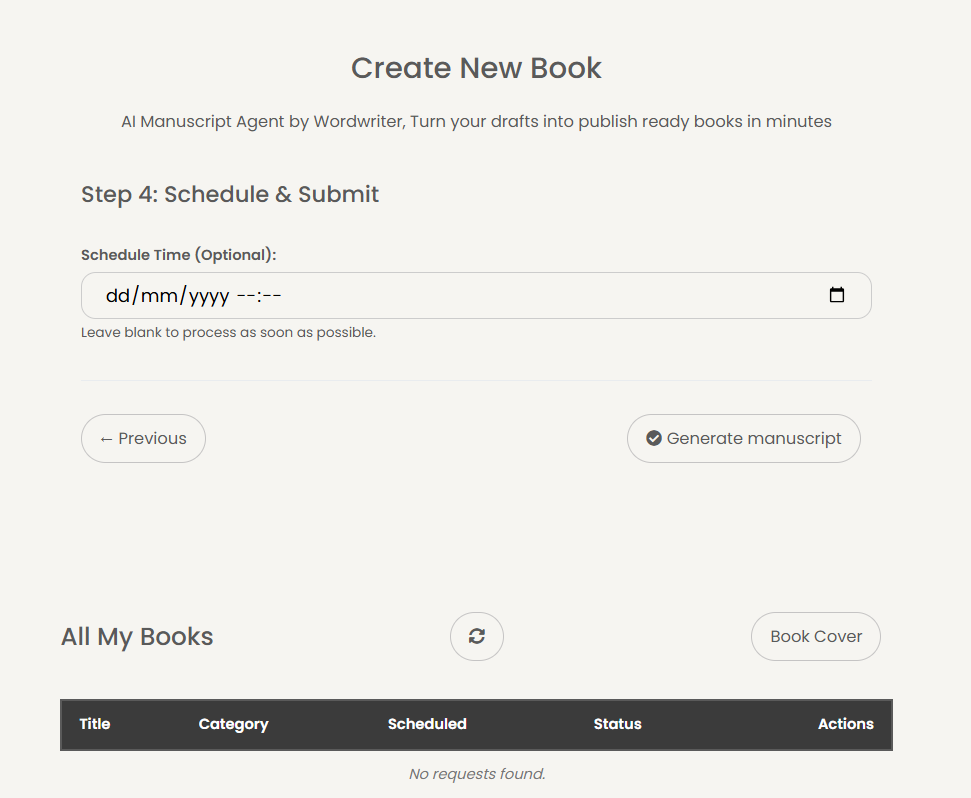
Finally, click Generate Manuscript to start the book creation process.
WordWriter will generate your non-fiction book based on the title, category, and content details you provided. You can review, edit, and refine the manuscript after generation.
Write and Publish Your Non-Fiction Book Faster With WordWriter
Writing a non-fiction book doesn’t have to be overwhelming or time-consuming. With WordWriter, you can move from idea to structured manuscript without getting stuck on outlines, organization, or where to start.
Instead of spending weeks planning, WordWriter helps you generate your title, book description, topics, and table of contents—all in one place. You stay in control of your message while the platform handles the heavy lifting.
If you’re ready to stop procrastinating and finally turn your knowledge into a finished non-fiction book, WordWriter gives you the tools to do it faster and with confidence.
Sign in to WordWriter today and start generating your non-fiction manuscript in minutes.
