
How to Write Quora Answers: Quick Tips with Examples
Quora is one of the largest social media platforms in the world, with over 300 million active users. Every day, between 3,000 and 5,000 new questions are asked on the platform.
Many businesses use Quora to position themselves as industry experts by answering questions related to their niche.
If you’re looking to leverage Quora for your business or personal brand, stay tuned — we’ll walk you through a step-by-step guide on how to write Quora answers that attract upvotes, shares, leads, and ultimately convert readers into customers using our Quora Answer Generator.
What is Quora?
Quora is a question-and-answer platform where people ask questions, share knowledge, and provide insights on virtually any topic. It was founded in 2009 and has grown into a global community with millions of users.
Users can:
- Ask questions about topics they’re curious about.
- Answer questions in areas where they have expertise or experience.
- Follow topics, people, and spaces to stay updated on specific interests.
- Build authority by providing valuable, well-written answers that get upvotes and shares.
For businesses and professionals, Quora is also a great platform for thought leadership, brand visibility, and lead generation, since high-quality answers can drive traffic and build trust with potential customers.
How to Write Quora Answers?
1. Analyze Your Niche
Before answering, spend some time researching your niche on Quora.
- Search for topics related to your industry. For example, if you’re in digital marketing, search “SEO,” “email marketing,” or “customer retention.”
- Identify trending questions — those with many followers or recent activity. These are likely to get higher visibility.
- Study top-performing answers — note their tone, structure, and how they deliver value.
Pro Tip: Focus on questions that align with your expertise and audience interest. Answering random questions outside your niche won’t attract the right leads.
2. Present Yourself as an Authority
Your Quora profile is your online reputation. It’s what convinces readers that your answers are trustworthy.
- Use a clear profile picture (preferably professional).
- Write a short, authoritative bio that highlights your expertise (e.g., “Digital Marketing Strategist | Helping brands grow through AI-powered content”).
- Include links to your website or company page in your bio and credentials section.
When answering, subtly reference your experience:
“Based on my 6 years managing eCommerce ads, I’ve found that…”
This establishes credibility without sounding promotional.
3. Generate Quora Answers Using WordWriter’s Quora Answer Generator
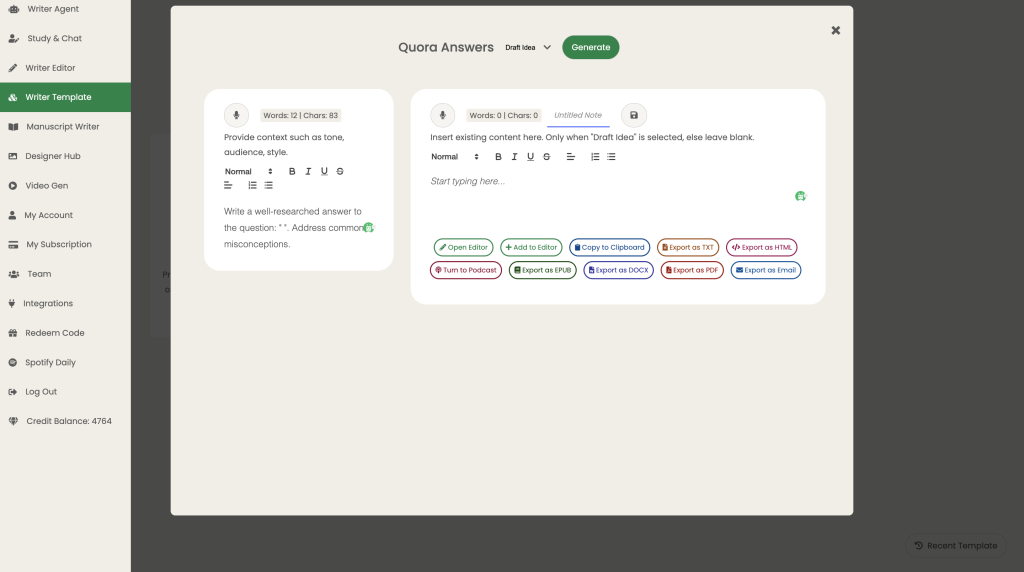
If you want to save time and maintain consistency, you can use the WordWriter Quora Answer Generator. Here’s how:
- Visit the WordWriter website.
- Login or click ‘Try for Free’ to access your dashboard.
- On the top-left corner, select ‘Writer Templates’.
- From the list of AI templates, choose ‘Quora Answers’.
- Enter your question, target keywords, and preferred tone (e.g., professional, friendly, persuasive).
- Click ‘Generate’ — WordWriter will produce a well-structured, engaging answer tailored to your niche.
- Review, personalize, and add your unique insights before posting.
Pro Tip: Always edit AI-generated answers to reflect your brand voice and add authenticity.
4. Add Links Strategically
Links are powerful for driving traffic — but they must be natural and relevant.
- Include links only when they add value to your answer.
- Instead of saying “Visit my website for more,” try: “You can explore more examples in this detailed guide I shared on [your website].”
- Use descriptive anchor text (avoid “click here”) and ensure your link matches the context.
Overlinking or sounding too promotional can get your answer downvoted or even flagged.
5. Provide Real Value (Don’t Just Promote)
Quora readers can quickly detect self-promotion. Instead, focus on educating or solving problems.
- Share personal stories, case studies, or examples that show your expertise.
- Offer step-by-step solutions or actionable tips readers can apply right away.
- Use a conversational tone — write like you’re explaining to a friend, not lecturing.
Example:
“When I first started running Facebook ads, my biggest mistake was targeting too broadly. Narrowing my audience by interest improved conversions by 45%.”
Authentic storytelling makes your answers relatable and memorable.
6. Use a Clear and Engaging Writing Style
A great answer is easy to read and visually appealing.
- Use short paragraphs (2–3 sentences max).
- Break ideas into bullets or numbered lists.
- Highlight key phrases in bold.
- Start with a hook — a question, stat, or bold statement — to grab attention.
Example:
“Most businesses fail on Quora because they treat it like an ad platform. But Quora rewards authenticity — not promotion.”
7. Support Your Points with Data or Research
Adding statistics or references makes your answer more credible.
- Quote reputable sources (e.g., HubSpot, Statista, or Harvard Business Review).
- Cite real results from your business or clients (without disclosing confidential data).
- Example: “According to HubSpot, 82% of customers feel more positive about a brand after reading its custom content — and Quora answers count as content marketing.”
8. End with a Subtle Call to Action (CTA)
Finish your answer with a light, value-based CTA. Avoid hard selling — invite curiosity.
Examples:
- “If you found this helpful, I share more tips like this on [your blog].”
- “I’ve written a detailed guide on this topic — feel free to check it out here.”
- “Follow me on Quora for more insights on [your niche].”
This approach drives clicks and followers without sounding pushy.
9. Engage After Posting
After your answer goes live:
- Check back regularly for comments and respond thoughtfully.
- Upvote and comment on other answers within your topic to stay visible.
- Update older answers with new insights or data — Quora rewards fresh content.
Engaging consistently helps you build credibility and attract followers over time.
10. Track Performance
Monitor how your answers perform using Quora stats. Look at:
- Views and upvotes (indicate reach and engagement).
- Click-throughs on your links.
- Follows gained after posting.
Use these metrics to refine your writing style and content strategy.
Quora Answers Generated using our Quora Answer Template
To demonstrate how WordWriter helps generate Quora answers, here’s an example of a question asked on Quora and the answer created by our tool.
Question: How do you write interesting content?
Answer: Writing interesting content is a process of combining deep audience empathy, a clear value proposition, and effective, structured delivery. It is a craft that can be systematically developed, not an innate talent. The core objective is to earn, capture, and hold the reader’s attention by offering something genuinely valuable, whether that is actionable knowledge, emotional resonance, entertainment, or a perspective that shifts their understanding.
Key Principles for Writing Interesting Content
1. Understand Your Audience with Granularity: The foundation of interesting content is radical relevance. To be interesting to someone, you must first understand who they are, what they desire, and what frustrates them.
- Map Their Problems and Questions: Go beyond basic keyword research. Use tools like Google Trends, AnswerThePublic, or forum discussions (like specific subreddits on Reddit or Quora topics) to find the exact phrasing and emotional context of the questions your audience is asking. Mine customer service emails and sales call transcripts for recurring pain points.
- Define Their Knowledge Gap: Content for a beginner must bridge the gap from “what they know” to “what they need to know next,” avoiding alienating jargon. Content for an expert must bridge the gap from “what they already know” to “what they don’t yet know,” avoiding boring oversimplification and offering novel insights.
- Discern Their Intent: Understand their “search intent” or motivation. Are they seeking a quick answer (Informational), looking for a specific website (Navigational), ready to buy something (Transactional), or comparing options before a decision (Commercial Investigation)? The format, depth, and call-to-action of your content must align with this intent.
2. Provide Demonstrable Value: A reader’s attention is a transaction. You must provide a clear and compelling return on their investment of time.
- Educate: Teach the reader how to execute a task with clear, step-by-step instructions, checklists, or downloadable templates. Provide frameworks and mental models that simplify complex topics.
- Inform: Offer new, non-obvious information. This can be through original research (like a survey), data synthesis (compiling and analyzing existing data in a new way), or by presenting an expert’s unique perspective on a current event.
- Solve a Problem: Directly address a specific “pain point.” Clearly articulate the problem (the “before” state) and present a clear, actionable solution that leads to a desirable “after” state.
- Entertain: Use humor, vivid storytelling, or compelling narratives to create an emotional connection. Entertainment builds brand affinity and makes the message more memorable.
- Inspire: Motivate the reader toward a goal or a new way of thinking. Use success stories, visionary ideas, and encouraging language to spark action.
3. Employ Proven Storytelling Techniques: Humans are neurologically wired to process and retain information through stories. Research from neuroeconomist Paul J. Zak shows that compelling narratives can release oxytocin, a hormone that increases feelings of trust, connection, and empathy.
- Leverage Narrative Structures: Even in technical or instructional content, you can use a narrative arc: a beginning (the problem/question), a middle (the journey of exploration, the steps, the data), and an end (the resolution/conclusion). Use classic formulas like the Problem-Agitate-Solve (PAS) model or a simplified Hero’s Journey.
- Use Anecdotes, Analogies, and Case Studies: Instead of merely stating a principle, illustrate it in action. An analogy can make an abstract concept concrete, while a case study provides real-world proof that your solution works.
- Position the Reader as the Hero: The reader is the protagonist. Frame your content as a guide, tool, or mentor that helps them (the hero) overcome a specific obstacle (the villain) to achieve their desired transformation (the victory).
4. Be Specific, Concrete, and Credible: Vague generalities are forgettable and unpersuasive. Specific details create vivid mental images, build credibility, and make your points stick.
- Quantify with Data and Statistics: Instead of “many people use smartphones,” write “According to Statista, over 6.6 billion people used smartphones in 2022, representing over 83% of the global population.” Always cite your sources to build trust. When possible, visualize data with charts or infographics to make it more digestible.
- Incorporate Sensory Details: When describing a situation, appeal to the senses. Don’t just say a process was “difficult”; describe the frustration, the late nights, or the blinking cursor on a blank screen.
- Provide Concrete Examples as Social Proof: If you claim a marketing strategy is effective, showcase a specific company that used it, the exact steps they took, and the quantifiable results they achieved. This functions as powerful social proof.
- Develop a Distinct and Authentic Voice: In a crowded digital landscape, a generic, robotic voice is invisible. Your voice is the personality of your writing—the unique combination of your word choice, sentence structure, and perspective. It’s not about being loud; it’s about being authentic and consistent.
- How to Develop Your Voice: Define a persona (e.g., The Mentor, The Investigator, The Witty Friend). Read your writing aloud to check if it sounds natural and human. Create a simple style guide that lists words you prefer, a tone you aim for (e.g., “helpful but not condescending”), and formatting rules you follow.
5. Prioritize Scannability, Clarity, and Structure: Interesting ideas are rendered useless by a dense “wall of text.” Excellent structure is a sign of respect for the reader’s time and makes your content effortless to consume.
- Use the Inverted Pyramid: Place the most critical information—the main point or conclusion—at the very beginning. This satisfies readers in a hurry and provides context for those who continue reading.
- Craft Informative Headings and Subheadings: These act as a roadmap, guiding the reader through your content and allowing them to scan for the sections most relevant to them.
- Keep Paragraphs Short: Aim for 1-4 sentences per paragraph. This improves whitespace and readability, which is especially critical for the majority of users reading on mobile devices.
- Use Lists and Formatting: Break up complex information into digestible, scannable chunks with bullet points and numbered lists. Use bolding for key phrases to emphasize the most important takeaways and help readers skim effectively.
Common Misconceptions
Reality: While trending topics can generate valuable short-term traffic, “evergreen” content that addresses timeless problems is a long-term asset. This content addresses the “long tail” of search, continuously attracting a targeted audience over months and years, building topical authority and becoming a reliable source of traffic and leads. Interesting is defined by relevance to the audience’s enduring needs, not the whims of the current news cycle.
Misconception: You need to be a “born writer.”
Reality: Writing is a craft built on deliberate practice. The most engaging content creators rely on formulas, audience research, multiple rounds of editing, and a structured process. Consistency, feedback, and a willingness to revise are far more important than any perceived innate talent.
Misconception: Interesting content must be “clickbait.”
Reality: A strong headline should create a “curiosity gap”—a space between what the reader knows and what your headline promises they’ll learn. This is effective and ethical. Clickbait, conversely, creates a deceptive gap and then fails to deliver, leading to reader frustration, high bounce rates, and a damaged reputation. The goal is sustained engagement built on trust, not a fleeting, disappointing click.
Misconception: Longer content is always better for SEO and value.
Reality: Value is determined by information density, not word count. The ideal length is precisely how long it takes to thoroughly and clearly solve the reader’s problem or answer their question, and no longer. Fluff and filler actively harm the user experience and dilute your message. A concise, 800-word article packed with actionable insights is far more valuable than a rambling 3,000-word post that says little.
Misconception: You must only cover trending topics.
Reality: While trending topics can generate valuable short-term traffic, “evergreen” content that addresses timeless problems is a long-term asset. This content addresses the “long tail” of search, continuously attracting a targeted audience over months and years, building topical authority and becoming a reliable source of traffic and leads. Interesting is defined by relevance to the audience’s enduring needs, not the whims of the current news cycle.
Conclusion
Mastering Quora answers takes strategy — from understanding your niche to delivering valuable insights that attract upvotes and conversions. However, writing consistently high-quality answers can be time-consuming. That’s where the WordWriter Quora Answer Generator comes in.
With just a few prompts, WordWriter helps you create engaging, well-structured Quora answers tailored to your audience, saving you hours of brainstorming and editing. Whether you’re building authority, driving traffic, or generating leads, WordWriter ensures your answers stand out.
Start crafting smarter, faster, and more impactful Quora answers today with WordWriter’s Quora Answer Generator.
